Strong structures depend on dependable ground conditions. A building, road, warehouse, bridge, or drainage system may look solid above ground, yet its long-term performance often starts with the soil below. Soil Testing gives engineers, contractors, developers, and property owners the technical data needed to plan foundations, earthworks, pavement support, and site preparation with greater confidence.
Soil may contain clay, sand, silt, gravel, organic matter, or mixed materials. Each type reacts differently to moisture, pressure, and structural loads. Some soils compress easily. Others expand during wet periods and shrink during dry periods. Certain areas may also contain loose layers, weak zones, or materials that require replacement or treatment before construction begins.
Professional Soil Testing helps identify these concerns before major site work starts. Inch-On Materials Laboratory provides Soil Testing based on recognized ASTM procedures, calibrated equipment, and clear reporting. Test results support sound engineering decisions, better quality control, and safer project outcomes.
What Is Soil Testing?
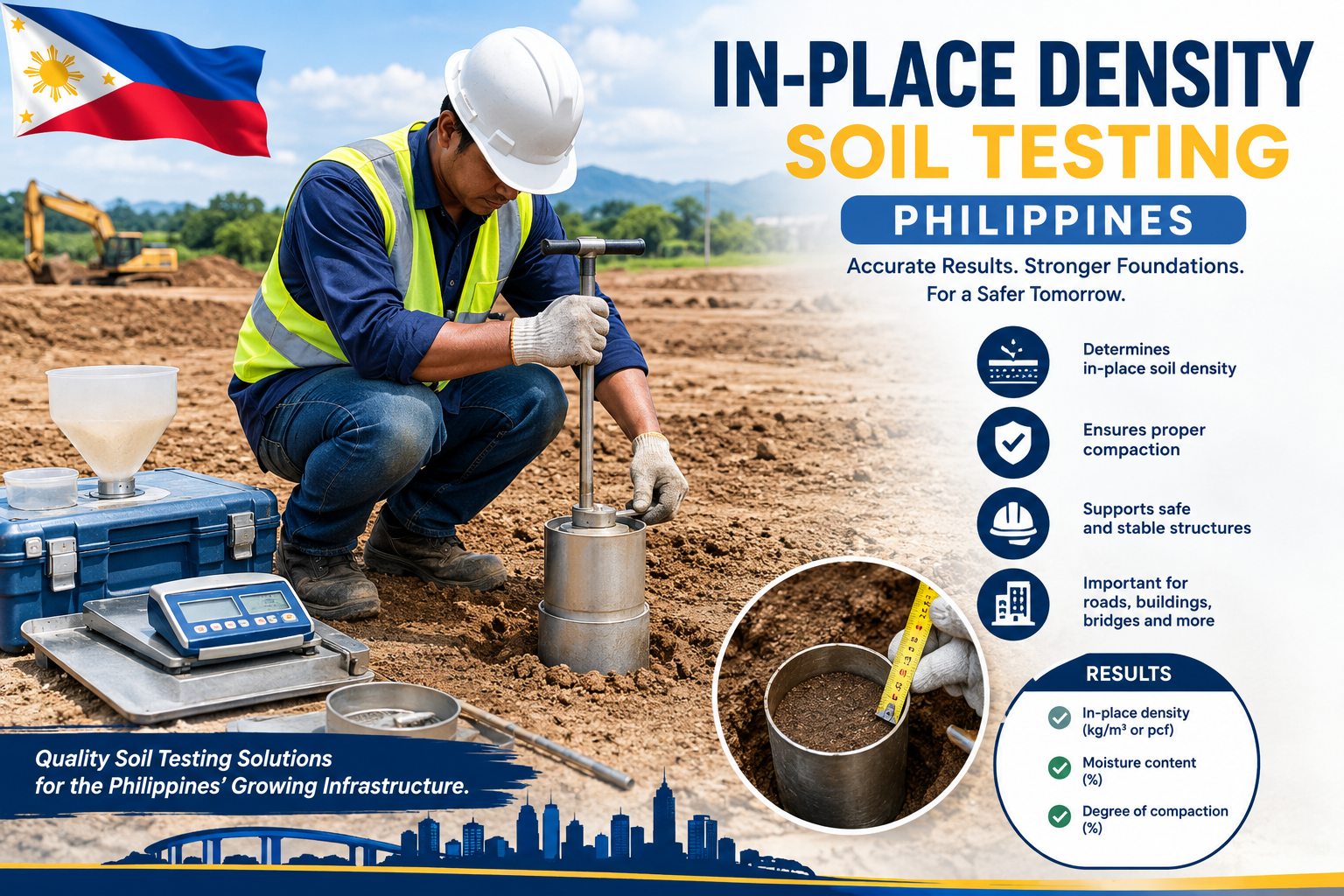
Soil Testing refers to field and laboratory procedures used to measure the physical and engineering properties of soil. The goal is to determine how soil may behave when subjected to load, moisture changes, compaction, excavation, or other construction activities.
A complete Soil Testing program may assess particle distribution, plasticity, moisture condition, penetration resistance, density, consistency, and soil classification. These values help project teams understand whether the ground can support a proposed structure or whether extra preparation may be required.
Visual assessment alone cannot provide enough detail for reliable design. Soil that appears firm at surface level may contain soft layers below. A dry site may also change once rainfall, drainage, or groundwater affects the ground. Soil Testing provides measurable results rather than assumptions.
Why Soil Testing Matters Before Construction
Soil Testing supports early risk reduction. Without proper data, a project team may select the wrong foundation type, underestimate settlement, or overlook moisture-sensitive materials. Such errors may lead to cracking, uneven floors, pavement deformation, leaning walls, drainage trouble, or costly corrective work.
Testing also supports more accurate project planning. Engineers can compare soil properties with expected structural loads, while contractors can plan excavation, compaction, filling, and ground preparation more effectively. Developers may also gain a clearer view of site requirements before final budgets are approved.
A proper Soil Testing program does not remove every construction risk, but it gives qualified professionals the information needed to make better decisions. That value becomes especially important for large structures, heavy facilities, road projects, slopes, retaining walls, and sites with variable ground conditions.
Soil Testing and Foundation Design
Foundation design depends on how soil reacts under pressure. Soil Testing helps engineers evaluate whether shallow footings, mat foundations, piles, or other systems may be suitable for a project.
Weak or loose soil may require deeper foundations, soil replacement, added compaction, or ground treatment. Dense granular soil may behave differently from soft clay, while expansive soil may require special design measures due to volume changes caused by moisture.
Soil Testing also helps reduce both overdesign and underdesign. Overdesign may raise material and labor costs without clear benefit. Underdesign may create serious performance and safety concerns. Accurate test data supports a foundation plan that matches actual site conditions.
Soil Testing and Settlement Risk
Settlement occurs when soil compresses under structural weight. Some settlement may be expected, but excessive or uneven movement can damage a structure. Differential settlement is especially concerning because separate parts of a building may move at different rates.
Soil Testing helps identify compressible layers, loose zones, and soil types that may present settlement concerns. Engineers can then estimate possible movement and recommend suitable solutions. These may include compaction, removal of weak material, preloading, drainage measures, stabilization, or deeper foundation support.
Early Soil Testing may save substantial repair costs. Cracked walls, distorted frames, sloping floors, damaged utilities, and jammed doors can result from soil movement. Prevention starts with a clear understanding of ground behavior.
Common Soil Conditions Revealed by Soil Testing
Soil Testing may reveal several conditions that affect construction performance. Loose granular soil may require compaction. High-plasticity clay may swell or shrink as moisture changes. Fine-grained soil may hold water and drain slowly. Organic material may compress or decay, making it unsuitable beneath foundations.
Testing may also identify poor particle distribution, excessive fines, unstable fill, variable layers, or unsuitable subgrade material. Each finding affects site planning differently.
No single soil condition should be judged without engineering review. Soil Testing provides the data, while qualified engineers interpret that data according to project loads, design goals, drainage conditions, and local requirements.
ASTM D1586 Standard Penetration Test
ASTM D1586 covers the Standard Penetration Test, often called SPT. This field procedure measures soil resistance to penetration and collects samples from subsurface layers.
During the test, a split-barrel sampler is driven into the ground through controlled hammer blows. The number of blows required for a set penetration distance provides an SPT value. That value helps professionals assess relative density for granular soil and consistency for cohesive soil.
SPT results also help identify changes across soil layers. A site may show firm soil near the surface but softer material at greater depth. Such information matters for foundation depth, pile design, excavation planning, and settlement assessment.
Soil Testing based on ASTM D1586 supports a clearer view of subsurface conditions. Results should always be reviewed together with boring logs, sample descriptions, groundwater observations, and other project data.
ASTM D4318 Atterberg Limits Testing
ASTM D4318 covers tests for liquid limit, plastic limit, and plasticity index. These values describe how fine-grained soil changes as moisture content changes.
The liquid limit represents the moisture condition where soil shifts toward liquid-like behavior. The plastic limit marks the lower moisture level where soil remains moldable. The plasticity index is calculated from the difference between those two values.
High plasticity often signals stronger sensitivity to moisture changes. Such soil may swell during wet periods and shrink during dry conditions. These movements may affect foundations, pavements, slabs, embankments, and earth structures.
Soil Testing through Atterberg limits supports soil classification and helps engineers assess workability, moisture sensitivity, and possible volume change. This test becomes especially valuable for clay-rich samples and projects where moisture variation may affect long-term performance.
ASTM D422 Particle Size Analysis
ASTM D422 has long been associated with particle size analysis for soil. The procedure separates soil particles according to size, helping classify gravel, sand, silt, and clay fractions.
Sieve analysis measures larger particles, while sedimentation methods assess finer material. The resulting distribution shows whether a sample is well graded, poorly graded, fine rich, or dominated by a particular particle group.
Particle size affects drainage, compaction, strength, permeability, and stability. Coarse soil may drain quickly, while fine soil may retain water. A broad range of particle sizes may compact differently from uniform material.
Soil Testing through particle size analysis helps project teams judge whether soil may be suitable for fills, subgrade, embankments, road base support, or other construction purposes. Results also support formal soil classification.
Soil Testing for Roads and Pavements
Roads and pavements depend heavily on subgrade quality. Weak soil below a pavement system may lead to rutting, cracking, depressions, pumping, or premature failure.
Soil Testing helps evaluate whether subgrade material can support traffic loads and seasonal moisture changes. Particle distribution, plasticity, density, and strength-related data may guide compaction targets, material replacement, stabilization, or drainage improvements.
Proper Soil Testing also supports better pavement thickness decisions. A weak subgrade may require extra support, while suitable material may reduce unnecessary construction costs. Reliable data helps balance performance, budget, and service life.
Soil Testing for Residential Projects
Homes, townhouses, apartments, and residential developments also benefit from Soil Testing. Even modest structures may experience damage when built over weak, expansive, loose, or uneven soil.
Testing helps identify likely foundation concerns before excavation and concrete work begin. Engineers may then select suitable footing depths, slab details, drainage measures, and compaction requirements.
Residential Soil Testing becomes especially useful for sloping lots, reclaimed areas, filled sites, former agricultural land, and properties with visible cracks or signs of ground movement. Early assessment may prevent repair expenses and disputes after project completion.
Soil Testing for Commercial and Industrial Projects
Warehouses, factories, office buildings, retail structures, and industrial facilities often place heavier loads on the ground. Floor slabs may support machinery, storage racks, vehicles, or production equipment. Foundations may also carry wide spans and concentrated loads.
Soil Testing provides data needed for these demanding conditions. Results may affect foundation selection, slab design, earthwork planning, drainage, and site grading.
Commercial and industrial projects also require dependable documentation for design coordination and quality control. Clear Soil Testing reports allow architects, engineers, contractors, and owners to work from the same technical information.
The Soil Testing Process
A Soil Testing program starts with project review. The laboratory or geotechnical team considers the type of structure, site size, expected loads, required standards, and available samples.
Next comes sampling. Representative samples must be collected, labeled, protected, and transported properly. Poor handling may change moisture condition or introduce contamination, which can affect results.
Laboratory preparation follows. Samples may be dried, separated, mixed, or conditioned according to the required procedure. Testing staff then perform each method with calibrated equipment and controlled steps.
After testing, results are reviewed and organized. Reports may include sample identification, test method, measured values, soil classification, observations, tables, and other relevant details. Engineers then apply the data to design and construction decisions.
Why Representative Sampling Matters
A laboratory test reflects the sample received. That means sample quality plays a major role. A sample taken from the wrong depth, mixed with foreign material, or poorly labeled may not represent actual site conditions.
Large or variable sites often require samples from several locations and depths. One sample cannot always describe a whole property. Filled areas, slopes, drainage paths, and former excavation zones may show very different soil behavior.
Proper coordination between field staff, engineers, and the testing laboratory helps protect sample quality. Soil Testing works best when sampling follows a clear plan tied to project needs.
How Soil Testing Reports Support Better Decisions
A well-prepared Soil Testing report turns measurements into organized technical information. The report may show particle size distribution, plasticity values, penetration resistance, sample descriptions, and classification results.
Clear reporting helps engineers compare values with design criteria. Contractors can also use the results for compaction, excavation, filling, and material control. Owners gain a documented record that supports project review and future reference.
Technical reports should be easy to follow without oversimplifying the data. Inch-On Materials Laboratory focuses on practical, readable reporting that supports construction teams and engineering professionals.
Why Choose Inch-On Materials Laboratory for Soil Testing?
Inch-On Materials Laboratory is an independent construction materials testing provider established during November 2018. The laboratory supports both laboratory and on-site testing services and follows recognized ASTM and AASHTO procedures.
DPWH-BRS accreditation adds another level of professional credibility for construction testing work. Clients can expect controlled procedures, calibrated equipment, documented results, and support for project quality requirements.
For Soil Testing, Inch-On Materials Laboratory performs methods related to ASTM D1586, ASTM D4318, and ASTM D422. These procedures help assess penetration resistance, plasticity, and particle distribution.
The laboratory also supports testing for coarse aggregates, fine aggregates, asphalt, reinforced steel bars, concrete hollow blocks, and other construction materials. This broad service range helps project teams coordinate several quality-control needs through one dependable provider.
Benefits of Professional Soil Testing
Professional Soil Testing offers clear practical benefits. It supports safer foundation design, better settlement assessment, stronger earthwork planning, and more accurate construction budgets.
Testing may also reduce delays caused by unexpected soil conditions. A project team that understands the ground early can plan equipment, labor, materials, and site treatment more effectively.
Soil Testing also creates a technical record. This record supports project documentation, design review, quality control, and communication among contractors, engineers, developers, and owners.
Most importantly, Soil Testing helps replace guesswork with data. That shift supports better decisions from site preparation through final construction.
Common Soil Testing Mistakes to Avoid
Skipping Soil Testing to save early costs can create larger expenses later. Visual checks, nearby project data, or assumptions about local soil may not reflect actual site conditions.
Another mistake is collecting too few samples. Soil may vary greatly across a property, especially where filling, grading, excavation, or erosion has occurred.
Poor sample labeling can also cause confusion. Each sample should have clear details about location, depth, date, and project reference.
Project teams should also avoid choosing tests without professional guidance. The correct Soil Testing scope depends on structure type, ground conditions, design requirements, and project risk.
When Should Soil Testing Be Performed?
Soil Testing should take place before final foundation design and before major site work begins. Early testing gives engineers enough time to review results and recommend changes where needed.
Testing may also be needed after soil replacement, during earthwork quality checks, before road construction, or before adding major loads to an existing site.
Existing structures with cracks, uneven floors, or signs of settlement may also require new assessment. Soil Testing can help support a broader engineering investigation of possible ground movement.
Soil Testing and Long-Term Structural Performance
A structure may remain exposed to rainfall, drought, drainage changes, vibration, traffic, and added loads across many years. Soil behavior may change as these conditions change.
Proper Soil Testing helps teams prepare for expected performance rather than focusing only on immediate construction. Moisture-sensitive soil, compressible layers, and weak subgrade may require specific controls to reduce future movement.
Long-term performance depends on many factors, including design, workmanship, drainage, maintenance, and material quality. Soil Testing provides one of the key technical foundations for those decisions.
Choose Reliable Soil Testing for Your Project
Every successful project needs accurate information about the ground below. Soil Testing supports foundation planning, settlement assessment, road design, site preparation, and construction quality control.
Inch-On Materials Laboratory provides Soil Testing through recognized procedures, calibrated equipment, and clear technical reporting. Whether the project involves a house, commercial building, road, warehouse, or civil works site, dependable soil data can help reduce uncertainty and support safer construction choices.
Choose Inch-On Materials Laboratory for Soil Testing that gives your project team practical results, organized documentation, and greater confidence before major construction work begins.
Frequently Asked Questions About Soil Testing
What is Soil Testing used for?
Soil Testing measures physical and engineering properties of soil. Results support foundation design, site preparation, roadwork, compaction, drainage planning, and construction quality control.
Why is Soil Testing needed before construction?
Soil Testing helps identify weak layers, settlement concerns, plasticity, particle distribution, moisture sensitivity, and other conditions that may affect structural performance.
What tests does Inch-On Materials Laboratory perform for soil?
The laboratory performs Soil Testing related to ASTM D1586, ASTM D4318, and ASTM D422. These methods assess penetration resistance, plasticity limits, and particle size distribution.
Can Soil Testing determine bearing capacity?
Soil Testing provides data that supports bearing capacity assessment. Final values and design decisions should come from qualified engineering professionals who review all site and structural information.
How does Soil Testing help prevent settlement?
Testing can reveal loose, compressible, weak, or variable soil layers. Engineers may then recommend compaction, soil replacement, stabilization, drainage measures, or deeper foundations.
What projects need Soil Testing?
Residential buildings, commercial structures, warehouses, factories, roads, bridges, drainage works, retaining walls, land developments, and other civil projects may require Soil Testing.
How many soil samples are needed?
Sample quantity depends on site size, project type, soil variability, structure loads, and engineering requirements. Larger or more variable sites usually require more sampling points.
How long does Soil Testing take?
Turnaround depends on the requested methods, sample quantity, sample condition, and current laboratory workload. Project teams should coordinate early to allow enough time for testing and engineering review.
What details appear on a Soil Testing report?
A report may include sample identification, test method, measured values, soil classification, particle distribution, plasticity results, penetration data, tables, and laboratory observations.
Why choose Inch-On Materials Laboratory?
Inch-On Materials Laboratory offers DPWH-BRS accredited construction testing services, recognized ASTM procedures, calibrated equipment, clear reporting, and support for several construction material categories.