Reinforced Steel Bar Testing plays a critical role in determining whether construction materials can support the loads, stresses, and environmental conditions expected in modern infrastructure. Steel reinforcement forms the backbone of concrete structures, and its performance directly affects building safety, durability, and long-term stability. Proper testing helps engineers and contractors confirm that every steel bar meets required mechanical properties before it is installed on-site.
Reinforced Steel Bar Testing follows strict engineering standards such as ASTM A370, which defines procedures for evaluating tensile strength, elongation, bending behavior, and other mechanical properties. These tests help confirm whether reinforcing steel bars match project specifications and structural design requirements.
Importance of Reinforced Steel Bar Testing in Construction
Reinforced Steel Bar Testing supports the foundation of safe construction practices. Concrete alone cannot handle high tensile forces, which is why steel reinforcement is added to carry tension loads. Without proper verification, weak or substandard steel can lead to cracking, deformation, or even structural failure.
Reinforced Steel Bar Testing ensures that materials perform as expected under real-world conditions. It helps construction teams confirm that steel delivered to the site matches approved mill certificates and design grades such as Grade 40, Grade 60, and Grade 75.
Reliable testing also supports compliance with building codes and engineering regulations. Projects that follow strict testing protocols gain stronger assurance of long-term durability and reduced maintenance risks.
Overview of Reinforced Steel Bar Testing Standards
Reinforced Steel Bar Testing follows internationally recognized standards to maintain consistency and accuracy. The most widely applied standard is ASTM A370, which defines mechanical testing methods for steel products.
ASTM A370 covers procedures for:
- Tensile strength evaluation
- Yield strength measurement
- Elongation and ductility assessment
- Bend testing for flexibility analysis
These standardized methods ensure that Reinforced Steel Bar Testing produces repeatable and reliable results across different laboratories and construction projects.
Additional references such as AASHTO standards also guide material quality requirements for infrastructure projects, especially in transportation and public works.
Mechanical Properties Evaluated in Reinforced Steel Bar Testing
Reinforced Steel Bar Testing examines several key mechanical properties that determine how steel behaves under stress. Each property provides essential insight into performance and safety.
Tensile Strength
Tensile strength measures the maximum force a steel bar can withstand before breaking. Reinforced Steel Bar Testing evaluates both yield strength and ultimate strength to ensure the material performs within safe limits.
Yield strength identifies the point where steel begins to deform permanently. Ultimate strength identifies the maximum load before failure occurs.
Elongation and Ductility
Elongation measures how much a steel bar can stretch before breaking. Reinforced Steel Bar Testing places strong focus on ductility because flexible steel performs better under seismic activity and heavy loading conditions.
High ductility allows structures to absorb energy during earthquakes or unexpected loads without sudden collapse.
Bend Performance
Bend testing evaluates how steel reacts when shaped or bent. Reinforced Steel Bar Testing ensures that reinforcing bars do not crack or break during fabrication and installation.
This property is especially important for construction projects requiring complex reinforcement layouts.
Testing Equipment Used in Reinforced Steel Bar Testing
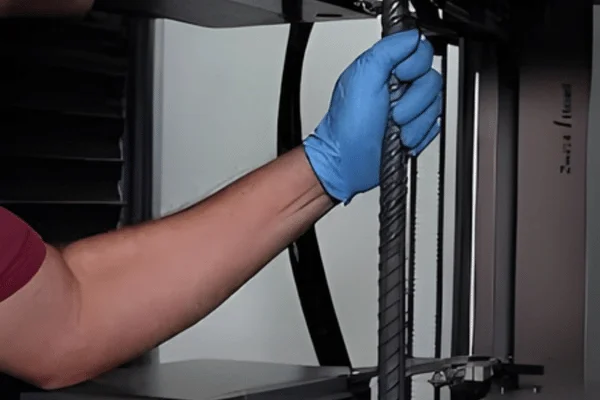
Reinforced Steel Bar Testing relies on precise and calibrated equipment to produce accurate results. The most important machine used is the Universal Testing Machine (UTM).
A UTM applies controlled force to steel samples while measuring stress and deformation. This allows technicians to record detailed mechanical behavior under increasing loads.
Modern Reinforced Steel Bar Testing facilities also include:
- Digital load measurement systems
- Extensometers for elongation tracking
- Calibration systems for accuracy control
- Data recording software for report generation
Accurate equipment ensures that Reinforced Steel Bar Testing results reflect real material performance.
Step-by-Step Process of Reinforced Steel Bar Testing
Reinforced Steel Bar Testing follows a structured procedure to maintain consistency and reliability.
Sample Collection
Steel samples are taken from delivered materials on-site or from stockpiles. Proper identification ensures traceability throughout the testing process.
Sample Preparation
Each sample is cut and prepared according to ASTM A370 requirements. Preparation ensures that test conditions remain consistent for every specimen.
Mechanical Loading
The prepared sample is placed inside a Universal Testing Machine. Force is applied gradually until the material yields and eventually breaks.
Data Recording
Throughout Reinforced Steel Bar Testing, data such as load, elongation, and failure point are recorded for analysis.
Report Generation
Final reports summarize results, including strength values, elongation percentages, and compliance status with project specifications.
Steel Grade Verification Through Reinforced Steel Bar Testing
Reinforced Steel Bar Testing plays a major role in verifying steel grades used in construction. Common grades include Grade 40, Grade 60, and Grade 75, each designed for specific structural applications.
Grade verification ensures that steel delivered to the project site matches approved specifications. Reinforced Steel Bar Testing compares actual performance with mill certificates to detect discrepancies or substandard materials.
This step helps prevent substitution issues where lower-grade steel is supplied instead of required higher-strength material.
Reinforced Steel Bar Testing and Structural Safety
Structural safety depends heavily on accurate Reinforced Steel Bar Testing results. Buildings, bridges, and infrastructure systems rely on steel reinforcement to resist tension, bending, and seismic forces.
Reinforced Steel Bar Testing ensures that steel bars maintain sufficient ductility and strength to perform under extreme conditions. This becomes especially important in regions exposed to earthquakes or high wind loads.
Reliable test results support engineers during design validation and help construction teams maintain safe building practices throughout project execution.
Role of Accredited Laboratories in Reinforced Steel Bar Testing
Accredited laboratories provide trusted results through standardized procedures and certified equipment. Reinforced Steel Bar Testing performed by accredited facilities ensures compliance with regulatory requirements and engineering codes.
Inch-On Materials Testing Laboratory performs Reinforced Steel Bar Testing following ASTM and AASHTO standards. The laboratory supports construction projects by delivering accurate mechanical test results for steel, soil, and concrete materials.
Accredited testing helps ensure that all results remain traceable, repeatable, and suitable for engineering approval.
Field and Laboratory Role in Reinforced Steel Bar Testing
Reinforced Steel Bar Testing often works alongside other material testing methods performed both on-site and inside laboratories.
Field testing focuses on real-time evaluation of construction materials and site conditions. Laboratory testing focuses on controlled mechanical analysis of steel samples.
Combining both approaches strengthens overall quality assurance. Reinforced Steel Bar Testing conducted in a controlled environment helps confirm results obtained from field inspections and material deliveries.
Common Issues Identified in Reinforced Steel Bar Testing
Reinforced Steel Bar Testing often reveals material issues that can affect structural safety and compliance.
Common findings include:
- Reduced tensile strength compared to specifications
- Low elongation values indicating poor ductility
- Incorrect steel diameter or mass variation
- Mismatch between mill certificates and actual performance
- Surface defects affecting structural behavior
Early detection through Reinforced Steel Bar Testing helps prevent costly corrections during or after construction.
Benefits of Reinforced Steel Bar Testing for Construction Projects
Reinforced Steel Bar Testing offers several important benefits for engineers, contractors, and project owners.
It improves structural safety by confirming material quality before installation. It supports compliance with building codes and project specifications. It also reduces the risk of material failure during construction or long-term use.
Reinforced Steel Bar Testing also helps streamline project approvals by providing certified documentation required for inspection and regulatory review.
Commitment to Quality in Reinforced Steel Bar Testing
Reliable Reinforced Steel Bar Testing depends on accurate procedures, calibrated equipment, and trained technicians. Consistency across every stage of testing ensures that results remain dependable for engineering decisions.
Laboratories that follow strict standards help construction teams maintain confidence in material selection and project execution. Reinforced Steel Bar Testing remains a key step in delivering safe and durable infrastructure.
FAQ: Reinforced Steel Bar Testing
What is Reinforced Steel Bar Testing?
Reinforced Steel Bar Testing evaluates the mechanical properties of steel reinforcement used in concrete structures. It measures strength, ductility, elongation, and bending performance.
Why is Reinforced Steel Bar Testing important?
Reinforced Steel Bar Testing confirms that steel materials meet engineering specifications and safety standards. It helps prevent structural failures and ensures long-term durability.
What standard governs Reinforced Steel Bar Testing?
ASTM A370 is the main standard used for Reinforced Steel Bar Testing. It defines methods for tensile, bend, and elongation testing of steel products.
What equipment is used in Reinforced Steel Bar Testing?
A Universal Testing Machine (UTM) is the primary equipment used. It applies controlled force to measure steel behavior under stress.
Who performs Reinforced Steel Bar Testing?
Reinforced Steel Bar Testing is performed by accredited construction materials laboratories such as Inch-On Materials Testing Laboratory.
What happens if steel fails Reinforced Steel Bar Testing?
Steel that fails Reinforced Steel Bar Testing is typically rejected for structural use and replaced with compliant material to maintain safety standards.
How often should Reinforced Steel Bar Testing be done?
Reinforced Steel Bar Testing should be performed for every batch of delivered steel or as required by project specifications and inspection protocols.