Rebound Hammer Test is a non-destructive testing method used to assess the surface hardness and estimate the compressive strength of hardened concrete. This method is widely applied during construction quality control and evaluation of existing structures where drilling or breaking concrete is not preferred.
Rebound Hammer Test plays an important role for engineers and inspectors who need fast field results without damaging structural elements. It helps identify variations in concrete quality across slabs, beams, columns, and other structural members. The method supports decision-making for repairs, rehabilitation, and acceptance of concrete work based on standard evaluation practices.
Rebound Hammer Test follows established testing guidelines such as ASTM C805, which defines procedures for measuring rebound number and interpreting results for hardened concrete.
What is a Rebound Hammer (Schmidt Hammer)?
Rebound Hammer Test uses a device commonly known as the Schmidt Hammer or concrete test hammer. This handheld instrument contains a spring-loaded mechanism that strikes the concrete surface with a controlled impact.
During the Rebound Hammer Test, the hammer plunger impacts the surface, and the device measures the rebound distance of the internal mass. The rebound value reflects the hardness of the concrete surface. Harder concrete produces higher rebound values, while weaker concrete produces lower readings.
Rebound Hammer Test provides a quick estimation of compressive strength, but it does not directly measure internal strength. Instead, it relies on correlation charts developed from laboratory calibration studies.
How Rebound Hammer Test Works
Rebound Hammer Test begins with surface preparation. The concrete surface must be clean, smooth, and free from loose particles, paint, or plaster. Testing points are selected based on structural element type and inspection plan.
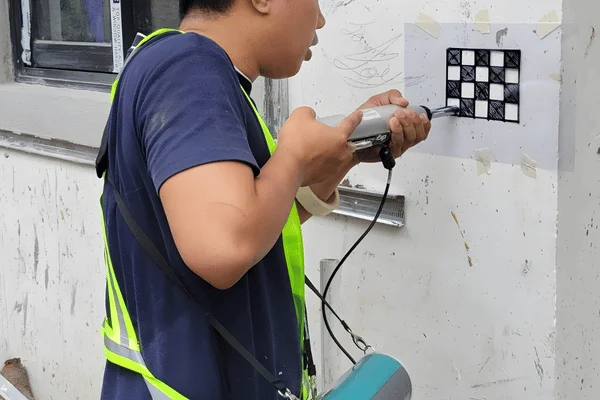
During the Rebound Hammer Test, the device is held perpendicular or at a specified angle depending on the structure being evaluated. The plunger is pressed firmly against the surface until the internal hammer is released.
The impact produces a rebound, which is displayed as a numerical value on the device scale. Multiple readings are taken at different points within the same test area to improve reliability.
Rebound Hammer Test results are recorded and averaged. The average rebound number is then converted into estimated compressive strength using standard conversion charts or calibration curves. These charts consider factors such as concrete age and surface condition.
Rebound Hammer Test results are influenced by several environmental and material factors, so proper technique and repeated measurements are important for accuracy.
Applications of Rebound Hammer Test
Rebound Hammer Test is widely used across different stages of construction and maintenance due to its speed and simplicity.
Concrete Strength Estimation
Rebound Hammer Test provides a quick estimate of compressive strength for newly poured concrete and existing structural elements. It is commonly used to check whether concrete meets design specifications.
Quality Control for Construction Projects
Rebound Hammer Test helps construction teams identify inconsistent concrete quality across different sections of a structure. It highlights areas that may require further investigation or corrective action.
Structural Condition Evaluation
Rebound Hammer Test is useful for assessing aging infrastructure such as bridges, buildings, and industrial facilities. It helps determine whether structural components remain within acceptable strength limits.
Material Uniformity Checks
Rebound Hammer Test detects variations in concrete quality within a single pour. This supports better quality assurance during large-scale construction works.
Step-by-Step Rebound Hammer Test Procedure
Rebound Hammer Test follows a structured process to ensure consistency and reliability.
Surface preparation is completed first to remove debris and ensure proper contact between the hammer and concrete surface. Test locations are selected based on structural drawings and inspection requirements.
Rebound Hammer Test is performed by pressing the hammer against the concrete surface until impact occurs. The rebound value is recorded for each test point.
Multiple readings are taken within a defined grid pattern. These readings are averaged to reduce variation caused by local surface irregularities.
Rebound Hammer Test data is then compiled into a report that includes test location, rebound values, average readings, and estimated compressive strength.
Interpretation of Rebound Hammer Test Results
Rebound Hammer Test results are expressed as rebound numbers, which are correlated to compressive strength values.
Higher rebound numbers indicate stronger and harder concrete surfaces, while lower values suggest weaker concrete or potential deterioration.
Rebound Hammer Test results may be affected by surface carbonation, moisture content, aggregate distribution, and testing angle. These factors must be considered during interpretation.
Rebound Hammer Test is most accurate when used on uniform concrete surfaces with proper calibration. For critical structures, results are often supported by additional testing methods.
Limitations of Rebound Hammer Test
Rebound Hammer Test evaluates only surface hardness and does not measure internal defects or deep structural issues.
Rebound Hammer Test results can be affected by surface conditions such as roughness, paint layers, or weather exposure. These factors may lead to variations in readings.
Rebound Hammer Test should not be used as the sole method for determining structural safety in critical engineering applications. It is best combined with other non-destructive or laboratory tests.
Rebound Hammer Test also requires proper operator training to ensure consistent and accurate results.
Rebound Hammer Test Compared with Other Concrete Tests
Rebound Hammer Test differs from destructive and other non-destructive methods used in construction assessment.
Core testing involves extracting concrete samples for laboratory compression testing. This method provides direct strength measurement but causes damage to the structure.
Ultrasonic Pulse Velocity testing evaluates internal concrete quality by measuring wave transmission speed. It detects internal voids and cracks that Rebound Hammer Test cannot identify.
Rebound Hammer Test is often used together with these methods to provide a more complete assessment of structural condition.
Combined testing improves accuracy and helps engineers make better decisions regarding structural integrity and maintenance planning.
Importance of Rebound Hammer Test in Construction
Rebound Hammer Test supports construction quality assurance by providing fast and cost-effective evaluation of concrete structures.
Rebound Hammer Test helps engineers identify potential issues early, reducing risks associated with structural failure or poor construction quality.
Rebound Hammer Test also supports maintenance planning for existing infrastructure by providing insight into material condition without causing damage.
Rebound Hammer Test is widely used in compliance verification to ensure structures meet required design standards.
Professional Rebound Hammer Test Services by Inch-On Materials Testing Laboratory
Rebound Hammer Test services provided by Inch-On Materials Testing Laboratory deliver accurate field evaluation supported by accredited procedures.
Inch-On Materials Testing Laboratory performs Rebound Hammer Test using calibrated equipment and standardized procedures aligned with ASTM C805 requirements.
Rebound Hammer Test services are conducted by trained personnel with experience in field testing of concrete structures across different project types, including buildings, bridges, and infrastructure developments.
Rebound Hammer Test is often combined with rebar scanning and other non-destructive evaluation services to provide a complete structural assessment. This integrated approach helps project engineers identify both surface conditions and internal reinforcement layout.
Rebound Hammer Test results provided by the laboratory support decision-making for construction acceptance, repair planning, and structural evaluation.
Why Accredited Rebound Hammer Test Services Matter
Rebound Hammer Test performed under accredited laboratories ensures higher reliability and consistency of results.
Accredited Rebound Hammer Test services follow strict calibration procedures and standardized testing methods. This reduces measurement errors and improves confidence in structural assessment.
Rebound Hammer Test conducted under DPWH-BRS accreditation supports compliance with government and engineering requirements for construction projects in the Philippines.
Reliable Rebound Hammer Test results help reduce construction risks and improve long-term structural safety.
Takeaway
Rebound Hammer Test remains one of the most practical and widely used non-destructive methods for evaluating concrete strength and surface condition. Its speed, simplicity, and cost efficiency make it valuable for both construction projects and structural assessments.
Rebound Hammer Test supports quality control, maintenance planning, and compliance verification across different types of structures. When performed by an accredited laboratory such as Inch-On Materials Testing Laboratory, results become more reliable and useful for engineering decisions.
Rebound Hammer Test works best when combined with other testing methods, creating a more complete understanding of structural condition and long-term performance.
Frequently Asked Questions About Rebound Hammer Test
What is a Rebound Hammer Test used for
Rebound Hammer Test is used to estimate concrete compressive strength and assess surface hardness without damaging the structure.
Is Rebound Hammer Test destructive
Rebound Hammer Test is non-destructive and does not require drilling or breaking concrete.
How accurate is Rebound Hammer Test
Rebound Hammer Test provides estimated strength values. Accuracy depends on calibration, surface condition, and proper testing procedures.
Can Rebound Hammer Test replace core testing
Rebound Hammer Test cannot replace core testing. It is used for quick assessment and should be supported by other testing methods for critical structures.
Where is Rebound Hammer Test commonly applied
Rebound Hammer Test is commonly used in buildings, bridges, slabs, columns, and infrastructure projects for quality control and inspection.
Why is Rebound Hammer Test important in construction
Rebound Hammer Test helps engineers assess concrete quality quickly, supporting safer construction decisions and maintenance planning.