Why In-Place Soil Density Matters in Philippine Construction
In-place soil density is an important measurement in construction because it helps determine whether compacted soil has reached the condition required by a project specification. For contractors, engineers, developers, and quality-control teams, in-place density soil Philippines testing provides field data that can be used to evaluate the effectiveness of soil compaction. Soil that is properly compacted generally provides a more stable platform for roads, foundations, slabs, embankments, and other constructed features. Poorly compacted soil, on the other hand, may be more susceptible to settlement, deformation, and uneven support. These concerns can become especially important when construction involves large earthwork areas, engineered fills, road subgrades, or backfilled sections. Field density testing allows construction professionals to verify actual conditions rather than relying only on the appearance of the compacted surface. ASTM recognizes in-place density testing as a quality-control and acceptance-testing tool for compacted soil and soil-aggregate materials.
What Is In-Place Soil Density?
In-place soil density refers to the mass of soil contained within a measured volume of soil in its existing field condition. Unlike a laboratory test performed on a controlled specimen, an in-place density test evaluates soil where it has been placed and compacted at the construction site. The measurement can be used to determine wet density and, after accounting for moisture, dry density. Dry density is particularly useful because it allows the field result to be compared with a laboratory-established maximum dry density. Moisture content is also important because the amount of water present in soil affects how effectively the soil particles can be compacted. A field density result therefore should not normally be considered by itself when evaluating whether compaction meets a project requirement. Proper interpretation requires an understanding of the soil material, laboratory reference values, project specifications, and testing procedure. For construction teams searching for in-place density soil Philippines, understanding these basic concepts makes it easier to interpret field test reports and communicate with testing laboratories.
Wet Density, Dry Density, and Moisture Content
Wet density represents the mass of soil and its contained moisture within a given volume, while dry density focuses on the mass of soil solids relative to that volume after accounting for water. This distinction is important because two soil samples can have similar wet densities but different moisture conditions and dry densities. Moisture content is commonly expressed as the ratio of the mass of water to the mass of dry soil solids. When soil is compacted near an appropriate moisture condition, the particles can generally rearrange more efficiently under the applied compactive effort. If the material is excessively dry, achieving the specified density may be difficult because the soil particles may not move into a sufficiently dense arrangement. If the soil contains too much water, the excess moisture can interfere with effective compaction and may produce undesirable field conditions. ASTM D6938 describes methods for measuring in-place density and moisture of soil and soil-aggregate using nuclear equipment and provides for determining dry density from measured conditions. Understanding these relationships is essential when interpreting soil density testing Philippines results.
How Field Density Testing Works
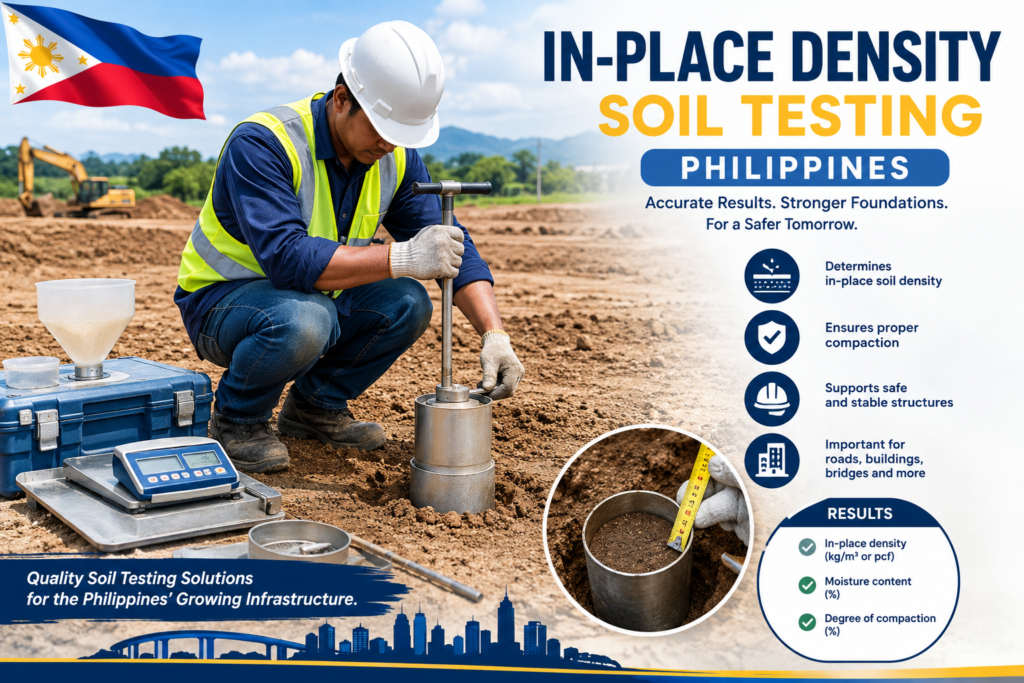
Field density testing involves measuring the density of compacted soil at a selected location and depth within a construction area. The specific procedure depends on the test method required by the project specification and the characteristics of the material being evaluated. The testing process generally produces information that can be used to determine the field density and, where applicable, moisture condition of the soil. The field dry density can then be compared with the appropriate laboratory maximum dry density to determine the degree of compaction. Philippine Department of Public Works and Highways documentation includes a worksheet for field density testing using AASHTO T 191, demonstrating the use of field measurements such as test-hole information, moisture content, and sand properties. Test locations should represent the work being evaluated rather than being selected solely because they are convenient to access. Accurate documentation of the location, layer, depth, material, and test results helps engineers and quality-control personnel determine whether the tested work complies with the applicable requirements.
Sand Cone Method for Field Density Testing
The sand cone method is a traditional approach for determining the density of soil in the field. It involves creating a test hole in the compacted soil and determining the volume of that hole using a calibrated quantity of sand. The mass of soil removed from the test hole is measured, while the volume of the hole is established through the calibrated sand procedure. Dividing the appropriate mass by the measured volume allows the field density to be determined. A moisture-content measurement can then be used to calculate the corresponding dry density. The DPWH field density worksheet specifically identifies AASHTO T191 and includes calculations involving the unit weight of air-dry sand, test-hole information, and moisture content. The sand cone method can therefore be useful when a project specification calls for this type of field density determination and the testing personnel have the appropriate equipment and training.
Nuclear Density Testing for Soil
Nuclear density testing provides another approach for evaluating soil density and moisture in the field. ASTM D6938 describes nuclear methods for measuring in-place density and water content of soil and soil-aggregate at shallow depths. The method can provide rapid, nondestructive measurements, allowing repeated measurements at a location when appropriate. Depending on the equipment and procedure, density measurements may use direct transmission or backscatter techniques. The method can also provide information used to determine dry density from wet-density and water-content measurements. Because nuclear equipment involves regulated radiation sources, testing must be performed by appropriately trained and authorized personnel while following applicable safety and regulatory requirements. ASTM also notes that the reliability of results depends on factors including personnel competence and the suitability of the equipment and facilities. For projects requiring in-place density soil Philippines services, the selected testing provider should therefore demonstrate that its equipment, procedures, personnel, and documentation are appropriate for the required test.
Maximum Dry Density and Optimum Moisture Content
Laboratory compaction testing provides an important reference for evaluating field compaction. One of the main values obtained from a compaction test is maximum dry density, which represents the highest dry density achieved under the specified laboratory compaction procedure and conditions. Another important value is optimum moisture content, which identifies the moisture condition associated with the maximum dry density for that laboratory procedure. These values provide a basis for comparing field performance against the laboratory reference. The degree of compaction is commonly expressed by comparing the field dry density with the applicable maximum dry density. However, the required percentage of compaction should always come from the applicable project specification rather than from a generic assumption. Different construction activities, materials, and project requirements can call for different acceptance criteria. Understanding maximum dry density and optimum moisture content helps contractors and engineers determine whether changes in moisture, compaction equipment, or construction procedures may be necessary.
Applications of In-Place Density Testing in the Philippines
In-place density testing can be applied to many types of earthwork and infrastructure projects in the Philippines. Road construction is one important application because compacted subgrade, embankment, subbase, and other layers need to meet specified construction requirements. Density testing may also be relevant for engineered fills used around structures or beneath constructed surfaces. Backfilled trenches and other excavated areas may require controlled placement and compaction to reduce the risk of later settlement. Embankments also require careful control because variations in compaction can affect the consistency and performance of the completed earthwork. Large development projects may involve extensive areas of fill where systematic testing helps quality-control personnel identify areas requiring additional attention. The specific testing frequency and acceptance requirements depend on the applicable project documents and specifications. For anyone researching in-place density soil Philippines, recognizing these applications helps clarify why field density testing is an important part of construction quality control.
Factors That Can Affect Soil Density Test Results
Several factors can influence the results obtained during an in-place density test. Soil type is one major factor because granular soils, cohesive soils, and mixed materials can respond differently to compaction equipment and moisture conditions. Moisture content is another critical factor because soil that is significantly too dry or too wet may not compact effectively. The type and operating condition of the compaction equipment can also affect the achieved density. Lift thickness matters because placing soil in excessively thick layers can make it difficult for compactive energy to reach the entire layer uniformly. The number of roller passes, vibration settings, travel speed, and equipment selection may also influence the final condition of the soil. Test location and surface preparation can affect the quality of the measurement, making proper field procedures important. ASTM D6938 likewise notes that test quality depends on competent personnel and suitable equipment and facilities, reinforcing the importance of proper testing practices.
What Happens When Soil Fails a Density Requirement?
A failed field density test means the tested material did not meet the applicable acceptance criterion at that particular test location. It does not automatically mean that the entire project area has failed, but it does indicate that the tested area requires evaluation. The construction team may investigate whether insufficient compaction effort, unsuitable moisture, excessive lift thickness, or material variation contributed to the result. Additional compaction may be appropriate when the material itself is acceptable but has not received sufficient compactive effort. Moisture adjustment may also be necessary when the soil is outside the condition required for effective compaction. In some circumstances, material that cannot achieve the specified condition may need to be reworked or replaced in accordance with the engineer’s direction and project requirements. Retesting is generally important after corrective work so that the revised field condition can be verified. Prompt attention to a failed result can help prevent poorly compacted soil from becoming hidden beneath subsequent construction layers.
Choosing an In-Place Density Soil Testing Laboratory
Selecting a qualified testing laboratory is an important step for projects that require reliable field density results. The laboratory should have personnel who understand the applicable test procedures and can properly operate the required equipment. It is also useful to confirm which ASTM, AASHTO, DPWH, or project-specific procedure will be followed before testing begins. The testing provider should be able to document test locations, material information, field measurements, laboratory reference values, and calculated results clearly. Equipment should be properly maintained and calibrated according to the requirements applicable to the selected testing method. For nuclear methods, the provider should also have appropriate procedures for equipment handling, safety, and regulatory compliance. ASTM emphasizes that reliable results depend on personnel competence as well as suitable equipment and facilities. When searching for in-place density soil Philippines services, construction teams should evaluate technical capability and documentation quality rather than choosing a provider based only on price or availability.
What Should Be Included in an In-Place Density Test Report?
A useful field density report should contain enough information for project personnel to understand exactly what was tested and how the result was obtained. Basic project information should identify the construction project, test date, test location, and relevant work area. The report should identify the tested layer and, where applicable, the depth or station reference associated with the test. Field measurements such as wet density, moisture content, and dry density should be clearly recorded when required by the test method. The laboratory maximum dry density and applicable reference information should also be identified when calculating the degree of compaction. The test method should be stated so that engineers can verify whether the procedure matches the project requirement. DPWH’s field density worksheet demonstrates the importance of recording information such as test-hole depth, location, layer representation, moisture content, and sand properties for the AASHTO T191 procedure. Clear reporting allows engineers, contractors, inspectors, and project owners to make better decisions about the tested work.
Common Mistakes in Soil Density Testing
One common mistake is assuming that a compacted surface looks acceptable simply because it appears firm or smooth. Visual inspection cannot provide the same quantitative information as a properly performed field density test. Another mistake is comparing a field result against the wrong laboratory reference value or an inappropriate compaction criterion. Ignoring moisture content can also lead to an incomplete understanding of why a particular density result was obtained. Testing only easily accessible areas can create an inaccurate picture of overall compaction quality if difficult areas are not properly represented. Failing to identify the specific layer being tested can make it difficult to determine which portion of the work the result actually represents. Poorly maintained equipment, inadequate calibration, or improper test execution can also affect reliability. Avoiding these problems requires coordination among the contractor, testing laboratory, quality-control team, and project engineer.
Practical Process for In-Place Density Soil Testing
A well-organized testing process begins by reviewing the project specifications and identifying the required acceptance criteria. The construction team should then determine the soil or fill material being placed and confirm the appropriate laboratory compaction reference. Soil should be placed in controlled layers and compacted using equipment suited to the material and project conditions. Representative locations should be selected for field density testing based on the applicable testing plan and project requirements. The selected field method, such as the sand cone or an appropriate nuclear method, should then be performed according to the applicable procedure. Moisture content and dry density should be evaluated as required, followed by comparison with the applicable laboratory reference and project criterion. Test results should be documented carefully, and areas that do not meet requirements should be addressed and retested as directed by the responsible project personnel.
FAQ About In-Place Density Soil Philippines
What is an in-place density test for soil?
An in-place density test measures the density of soil in its actual field condition after placement and compaction. The result helps construction professionals evaluate whether the soil has reached the density required by the project specifications. Depending on the selected method, the test may also provide information about moisture content. Field dry density can then be compared with an appropriate laboratory reference value. This makes the test useful for construction quality control. The exact procedure depends on the project requirements and applicable testing standard. Properly performed testing provides measurable information that is more useful than relying solely on visual observations.
Why is in-place soil density testing important in the Philippines?
In-place soil density testing helps verify the quality of compacted earthwork in construction and infrastructure projects. It can be relevant to roadwork, embankments, engineered fills, backfills, and other applications where soil stability and uniformity matter. Testing can identify areas where compaction has not reached the required condition. This gives contractors an opportunity to correct problems before subsequent layers conceal the affected material. Philippine DPWH documentation includes field density testing procedures and worksheets for applicable construction work. Project-specific specifications should always be checked because requirements can vary according to the type of work. This is why in-place density soil Philippines testing is an important quality-control consideration for many construction projects.
What is the difference between in-place density and laboratory density?
In-place density describes the density of soil measured at the construction site. Laboratory density values are obtained under controlled laboratory procedures and can provide reference information for evaluating field compaction. Maximum dry density from laboratory compaction testing is commonly used as a comparison point for field dry density. The two measurements therefore serve different purposes but work together during quality control. Field testing shows what was actually achieved at the site. Laboratory testing establishes a controlled reference under a specified procedure. Both must be interpreted according to the project specifications and applicable standards.
What is the sand cone method?
The sand cone method determines the volume of a field test hole using calibrated sand. The mass of soil removed from the hole is measured so that density can be calculated from mass and volume. Moisture content can then be determined to support calculation of dry density. AASHTO T191 is associated with this type of field density testing, and DPWH documentation includes a corresponding field density worksheet. The method requires proper preparation, calibrated equipment, and trained personnel. Its suitability depends on the material and project requirements. When specified appropriately, it can provide useful field density information for construction quality control.
Is nuclear density testing used for soil?
Yes, nuclear methods can be used to measure in-place density and water content of soil and soil-aggregate. ASTM D6938 describes such methods and identifies their use for quality control and acceptance testing of compacted materials. One advantage is that measurements can be obtained rapidly without removing a conventional soil sample for every density measurement. However, nuclear equipment requires appropriate personnel, procedures, equipment controls, and safety practices. The selected method must also be suitable for the material and project conditions. A qualified testing provider should handle the equipment in accordance with applicable requirements. Project specifications should determine whether this method is acceptable for the particular work.
What happens if soil does not meet the required density?
A result below the specified requirement should be investigated rather than simply ignored. The project team may examine moisture condition, compaction effort, lift thickness, equipment selection, and material characteristics. Additional compaction may resolve the issue when the material is otherwise acceptable. Moisture adjustment may also be necessary when the soil is too dry or too wet for effective compaction. If the material itself is unsuitable, reworking or replacement may be required. After corrective work, additional testing can verify whether the affected area now meets the applicable requirement. All corrective measures should follow the project specifications and the direction of the responsible engineer or authorized project personnel.
How often should field density tests be performed?
There is no single testing frequency that applies to every construction project. Frequency can depend on the type of earthwork, material, project specifications, governing agency requirements, and quality-control plan. Philippine DPWH documentation demonstrates that testing requirements can be associated with particular work items and specified frequencies. The appropriate frequency should therefore be established before fieldwork begins. Testing should also represent the construction work adequately rather than focusing only on convenient locations. Contractors should coordinate with the project engineer and testing laboratory when determining the required testing schedule. Following the approved testing plan helps provide more reliable quality-control documentation.
How can a project arrange in-place density soil testing in the Philippines?
A project team should first identify the type of construction work and the material that needs to be tested. It is useful to provide the testing laboratory with project specifications, location information, required test method, and applicable acceptance criteria. The laboratory can then determine the equipment, personnel, and field procedure needed for the assignment. Test locations and timing should be coordinated so testing occurs after the relevant soil layer has been properly placed and compacted. The resulting report should clearly identify the tested location, material, measurements, calculations, and applicable reference values. Any failed results should be communicated promptly to the project team for appropriate corrective action. Choosing a technically capable testing provider can help ensure that in-place density soil Philippines requirements are addressed with appropriate field procedures and documentation.
Key Takeaway
In-place density soil Philippines testing provides valuable field information for evaluating the quality of compacted soil in construction projects. It helps determine whether soil has reached the density required by the applicable project specifications. Methods such as the sand cone procedure and nuclear density testing can be used when they are appropriate for the material and specified work. Laboratory compaction results, particularly maximum dry density and optimum moisture content, provide important reference information for interpreting field results. Moisture condition, soil type, lift thickness, compaction equipment, and testing procedures can all influence the final density achieved. A reliable testing program requires qualified personnel, suitable equipment, appropriate standards, representative test locations, and accurate documentation. For contractors, engineers, developers, and project owners in the Philippines, understanding field density testing can support better earthwork quality control and help identify compaction issues before they affect later stages of construction.