Concrete is the backbone of modern construction, and verifying its strength is essential for safety, durability, and long-term performance. The Rebound Hammer Test provides an effective way to evaluate concrete quality without causing damage to structures. This non-destructive testing method delivers rapid results, helping engineers, contractors, and project managers make informed decisions on construction quality and maintenance requirements.
Inch-On Materials Testing Laboratory, a DPWH-BRS accredited laboratory, offers professional Rebound Hammer Test services across the Philippines. With high-precision equipment and strict compliance with ASTM C805 standards, Inch-On delivers accurate assessment of concrete surface hardness and compressive strength. Combining this test with rebar scanning provides a complete picture of structural integrity without compromising the material.
What is a Rebound Hammer Test
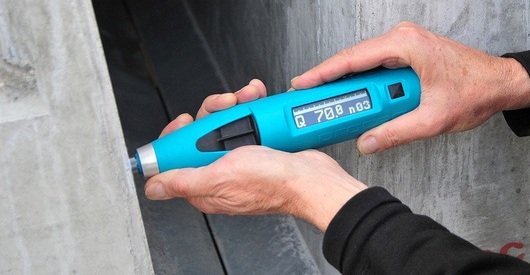
The Rebound Hammer Test is a non-destructive method designed to assess the surface hardness of hardened concrete and provide an estimate of its compressive strength. It relies on a spring-driven device known as a Schmidt Hammer, which strikes the concrete surface and measures the rebound of the hammer mass. The rebound value directly correlates to the concrete’s compressive strength, making it a valuable tool for evaluating in-place concrete elements quickly and safely.
Unlike traditional destructive methods, which require taking core samples that can weaken or damage structures, the Rebound Hammer Test delivers results without altering the concrete. This allows engineers to monitor existing structures, verify new construction quality, and make informed decisions about rehabilitation or maintenance.
Why Rebound Hammer Testing Matters
Concrete performance is critical for structural stability, and using the Rebound Hammer Test provides several benefits that support construction quality control. By performing this test, low-strength areas within structural elements such as slabs, beams, and columns can be detected early, allowing corrective measures before further construction progresses.
Rebound Hammer Testing is particularly valuable for existing structures, where assessing surface deterioration can help determine whether repairs or rehabilitation are needed. It also ensures uniformity across concrete pours, providing peace of mind that there are no hidden weak spots in the structure. This is especially important in large-scale construction projects where variations in concrete quality may occur during mixing, pouring, or curing processes.
How the Test Works
The Rebound Hammer Test is straightforward but requires proper technique to yield accurate results. The process begins with calibrating the Schmidt Hammer to ensure consistent readings. The hammer is then applied to the surface of the concrete at a right angle, and the rebound value is recorded. Multiple readings are usually taken across different areas to assess uniformity and detect low-strength zones.
After collecting the readings, engineers compare them against reference curves or standard tables to estimate compressive strength. The results allow for rapid assessment on-site without interrupting construction work. Proper technique and trained operators are essential for reliable outcomes, as incorrect angles, surface moisture, or surface roughness can affect the measurements.
Advantages of Non-Destructive Testing
The Rebound Hammer Test is a prime example of non-destructive testing (NDT) for concrete structures. Unlike core sampling or other destructive methods, this test leaves the concrete surface intact, reducing repair costs and preserving structural integrity.
Testing is also fast and efficient, allowing multiple locations to be assessed in a short period. Engineers receive immediate feedback about concrete quality, making it easier to plan corrective actions if necessary. Non-destructive testing is suitable for both newly constructed and existing structures, providing flexibility for project managers and maintenance teams alike.
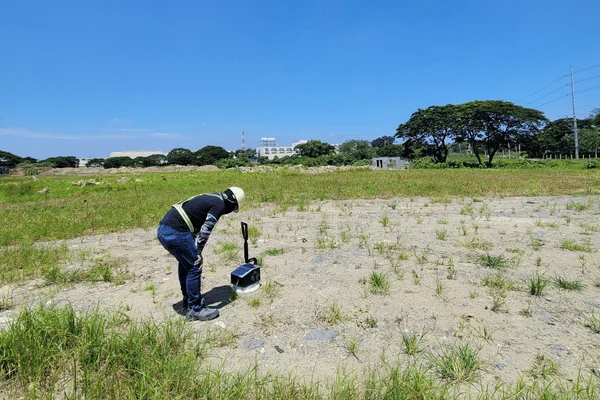
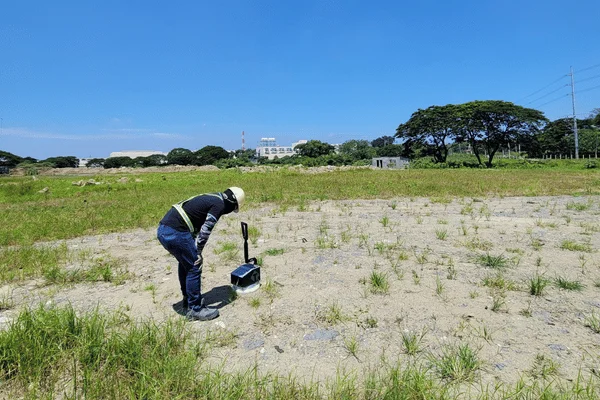
The Rebound Hammer Test also complements other NDT methods, such as high-precision rebar scanning, enabling a comprehensive evaluation of both surface hardness and internal reinforcement. This combination enhances safety during retrofitting, cutting, or coring operations by identifying safe zones and locating critical elements accurately.
Applications of Rebound Hammer Testing
The Rebound Hammer Test has a wide range of applications across construction and infrastructure projects. It is commonly used on concrete slabs, beams, columns, walls, and foundations to ensure quality control during construction. Engineers rely on the test to detect variations in concrete strength across different areas, helping prevent structural issues caused by low-quality concrete.
Rebound Hammer Testing is also valuable for bridges, flyovers, industrial facilities, and commercial buildings. It assists maintenance teams in evaluating surface wear and deterioration in older structures, providing the data needed to plan repairs or retrofits. Pre-renovation assessments benefit from this method as well, allowing contractors to verify the condition of concrete before any modification or coring.
This test ensures that concrete meets project specifications while maintaining safety and efficiency. By identifying weak areas early, construction teams can address potential problems without delays or unnecessary costs. The Rebound Hammer Test is a reliable tool that supports both quality control and long-term structural performance.
Why Choose Inch-On Materials Testing Laboratory
Inch-On Materials Testing Laboratory is a DPWH-BRS accredited engineering and construction testing facility that has been providing professional services since November 2018. The laboratory operates independently and specializes in soil and construction material testing, as well as on-site evaluation of concrete and foundation piles.
The laboratory’s team follows strict ASTM and AASHTO standards to ensure consistent and accurate testing results. Inch-On offers Rebound Hammer Test services using calibrated Schmidt Hammers operated by trained personnel. Combining this with rebar scanning services allows clients to assess both concrete surface hardness and internal reinforcement without causing structural damage.
Inch-On delivers nationwide services across the Philippines, making it a trusted partner for contractors, engineers, and project managers seeking reliable and efficient non-destructive testing. Choosing Inch-On ensures that construction projects maintain safety, compliance, and long-term structural performance.
Tips for Accurate Testing
Accuracy in Rebound Hammer Testing depends on proper preparation and technique. Concrete surfaces should be clean, dry, and smooth to avoid skewed readings. Rough surfaces, debris, or wet conditions can affect rebound values, so preparation is essential for reliable results.
Calibrating the Schmidt Hammer before use is critical. Operators should apply the hammer at a right angle to the surface and take multiple readings at each test location. Averaging the results helps minimize anomalies and provides a more accurate estimation of compressive strength.
Testing should cover representative areas across structural elements to detect low-strength zones or inconsistencies. Following standardized procedures and relying on trained personnel ensures that the Rebound Hammer Test delivers trustworthy information for decision-making.
Common Misconceptions About Rebound Hammer Testing
A common misconception is that Rebound Hammer Testing alone provides precise compressive strength values. While the test offers a good estimate, it works best when combined with other assessments or confirmed by laboratory tests when high accuracy is critical.
Another misunderstanding is that the test damages concrete. Properly conducted, Rebound Hammer Testing is non-destructive, leaving the surface intact. Finally, some assume the test can replace all structural evaluations. While it is valuable for quick assessments and quality control, engineers may still need complementary tests, such as rebar scanning or core sampling, for full structural analysis.
Takeaway
The Rebound Hammer Test offers a fast, efficient, and non-destructive way to evaluate concrete strength and surface durability. It provides engineers and contractors with the information needed to ensure structural safety, monitor deterioration, and maintain construction quality.
Inch-On Materials Testing Laboratory combines Rebound Hammer Testing with high-precision rebar scanning, delivering a complete assessment of both concrete surface hardness and internal reinforcement. Nationwide service coverage, DPWH-BRS accreditation, and strict compliance with ASTM standards make Inch-On a trusted partner for construction projects across the Philippines.
Schedule a Rebound Hammer Test with Inch-On today and ensure your concrete structures meet quality standards, safety requirements, and long-term performance expectations.
FAQ About Rebound Hammer Test
What is the Rebound Hammer Test used for?
The Rebound Hammer Test is used to estimate concrete compressive strength, assess surface hardness, identify low-strength zones, and monitor deterioration in both new and existing structures.
Is the Rebound Hammer Test destructive?
No, the test is non-destructive. It leaves the concrete surface intact and does not compromise structural integrity.
How accurate is the Rebound Hammer Test?
The test provides a reliable estimate of concrete strength. Accuracy improves when multiple readings are taken, proper calibration is performed, and testing conditions are controlled.
Can the Rebound Hammer Test detect internal reinforcement?
The Rebound Hammer Test primarily measures surface hardness. For locating internal reinforcement, a complementary service such as rebar scanning using GPR or electromagnetic methods is recommended.
Who should perform the Rebound Hammer Test?
Trained and experienced personnel should conduct the test to ensure accurate and consistent results. Inch-On Materials Testing Laboratory employs certified professionals for this purpose.
Which standard does the Rebound Hammer Test follow?
The test follows ASTM C805, a standard for measuring concrete surface hardness and estimating compressive strength.
Can the Rebound Hammer Test be used on existing structures?
Yes, it is ideal for assessing aging structures, monitoring surface wear, and planning rehabilitation without causing damage.
How long does the Rebound Hammer Test take?
Testing is fast and can be completed on-site in a short period, depending on the size and complexity of the structure.